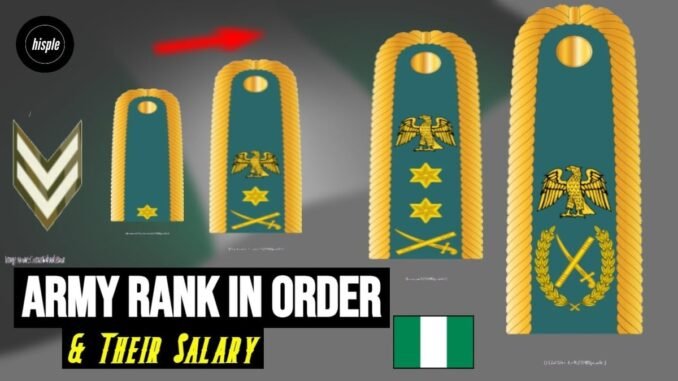
Nigeria Army salary now ranges from ₦187,200 for a Private to ₦3.25 million for a General, following a new pay structure that took effect on September 1, 2026. President Bola Tinubu approved the salary review with increases ranging from 30% to 80% depending on rank, benefiting about 250,000 personnel across the Army, Navy, and Air Force.
What Changed in the Nigeria Army Salary Structure in 2026?
The Nigerian government raised military pay in three tiers based on rank. Personnel from Private to Staff Sergeant received the highest increase, at 80%. Personnel from Warrant Officer to Colonel received a 50% increase. Officers above Colonel, including Brigadier-Generals, Major-Generals, Lieutenant-Generals, and Generals, received a 30% increase. The review pushed the Armed Forces’ annual wage bill from ₦660 billion to ₦924 billion.
What Is the Full Nigeria Army Salary Table for Non-Commissioned Ranks?
The table below shows the old and new monthly salary for non-commissioned ranks.
| Rank | Old Monthly Salary | New Monthly Salary | Increase |
|---|---|---|---|
| Private | ₦104,000 | ₦187,200 | ₦83,200 (80%) |
| Lance Corporal | ₦112,000 | ₦201,600 | ₦89,600 (80%) |
| Corporal | ₦115,000 | ₦207,000 | ₦92,000 (80%) |
| Sergeant | ₦125,000 | ₦225,000 | ₦100,000 (80%) |
| Staff Sergeant | ₦150,000 | ₦270,000 | ₦120,000 (80%) |
| Warrant Officer | ₦170,000 | ₦255,000 | ₦85,000 (50%) |
| Master Warrant Officer | ₦210,000 | ₦315,000 | ₦105,000 (50%) |
| Army Warrant Officer | ₦230,000 | ₦345,000 | ₦115,000 (50%) |
What Is the Full Nigeria Army Salary Table for Commissioned Officers?
Commissioned officers, who typically enter through the Nigerian Defence Academy or graduate officer programs, earn considerably more than non-commissioned ranks.
| Rank | Old Monthly Salary | New Monthly Salary | Increase |
|---|---|---|---|
| Second Lieutenant | ₦240,000 | ₦360,000 | ₦120,000 (50%) |
| Lieutenant | ₦280,000 | ₦420,000 | ₦140,000 (50%) |
| Captain | ₦320,000 | ₦480,000 | ₦160,000 (50%) |
| Major | ₦380,000 | ₦570,000 | ₦190,000 (50%) |
| Lieutenant Colonel | ₦420,000 | ₦630,000 | ₦210,000 (50%) |
| Colonel | ₦580,000 | ₦870,000 | ₦290,000 (50%) |
| Brigadier-General | ₦750,000 | ₦975,000 | ₦225,000 (30%) |
| Major-General | ₦1,150,000 | ₦1,495,000 | ₦345,000 (30%) |
| Lieutenant General | ₦1,900,000 | ₦2,470,000 | ₦570,000 (30%) |
| General | ₦2,500,000 | ₦3,250,000 | ₦750,000 (30%) |
What Allowances Do Nigerian Army Personnel Receive Beyond Basic Salary?
Nigerian Army pay is governed by the Consolidated Armed Forces Salary Structure (CONAFSS), which covers more than basic salary alone. Personnel receive several mandatory allowances, including:
- Rent subsidy and house upkeep allowance
- Utility allowance
- Leave grant
- Uniform maintenance allowance
- Hazard allowance
- General services and entertainment allowance
- Transport allowance
- Non-practising and hardlying allowance
- Retention incentive and qualifying pay allowance
- Furniture and command expenses allowance
- Meal subsidy
Personnel posted between duty stations may also receive a Packing on Posting Allowance equal to 5% of annual CONAFSS at Step 5 of their rank. Retiring or discharged personnel receive a Terminal Packing Allowance equal to 10% of annual CONAFSS at Step 5. Personnel without barracks or government accommodation receive a lodging allowance equal to 40% of CONAFSS. Additional allowances apply for specialized operations, including amphibious duties, diving, special warfare, and counter-terrorism operations.
How Does Nigeria Army Salary Compare to Other African Countries?
Nigerian soldier pay remains lower than several regional counterparts even after the September 2026 increase.
| Country | Entry-Level Monthly Pay (Naira Equivalent) |
|---|---|
| Nigeria (new rate) | ₦187,200 |
| South Africa | ₦715,607 to ₦1,010,000 |
| Kenya | ₦212,908 to ₦747,383 |
| Togo | ₦767,564 |
| Cameroon | ₦803,046 |
| Benin Republic | ₦661,892 |
| The Gambia | ₦195,910 |
| Senegal | ₦547,000 |
| Niger Republic | ₦526,962 |
Who Governs Nigeria Army Salary Payments?
The Manual for Financial Administration of the Armed Forces of Nigeria (MAFA), signed in 2018, governs personnel remuneration alongside the Consolidated Armed Forces Salary Structure, directives from the National Salaries, Incomes and Wages Commission, the Public Service Rules, and the Harmonised Terms and Conditions of Service. The Minister of Defence had previously disclosed that the administration raised the minimum monthly soldier salary from ₦49,000 to ₦100,000 before this latest review took effect.
What Do Soldiers Say About the New Salary Structure?
Reactions from serving personnel have been mixed. Some soldiers note that rising food, housing, and school fee costs offset the value of the raise, since personnel also cover their own uniform and equipment costs from salary. Civil society groups, including Accountability Lab Nigeria and the International Society for Social Justice and Human Rights, have called for the increase to be measured against actual purchasing power and cost of living rather than the nominal percentage announced. The Committee for the Defence of Human Rights described the review as a positive first step relative to Nigeria’s broader economic conditions.
People Also Ask
What is the current salary of a Private in the Nigerian Army?
A Private earns ₦187,200 monthly under the salary structure that took effect September 1, 2026, up from ₦104,000 previously.
What is the salary of a General in the Nigerian Army?
A General earns ₦3.25 million monthly under the new structure, up from ₦2.5 million.
When did the new Nigeria Army salary take effect?
The new pay structure took effect on September 1, 2026, though some units may see the adjusted figures reflect in their accounts slightly later.
Does Nigeria Army salary include allowances?
No. The figures above represent basic salary. Personnel also receive allowances for rent, transport, hazard duty, uniform maintenance, and other categories under CONAFSS.
What Is the Outlook for Nigeria Army Salary?
The September 2026 pay review represents one of the largest military salary increases in recent Nigerian history, raising the Armed Forces’ annual wage bill by ₦264 billion. Despite the increase, Nigerian military pay remains below several regional counterparts, and further reviews may follow as the government continues to link troop welfare to broader efforts to modernize the Armed Forces and address ongoing security operations across the country.
Be the first to comment