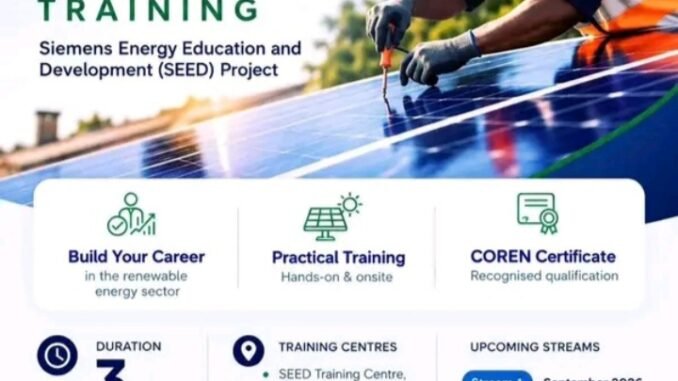
The Siemens Energy Education and Development (SEED) Solar PV Installation (SPVI) Training is an opportunity for professionals, technicians and other interested individuals who want to build practical skills in solar photovoltaic installation and renewable energy.
The training is supported by the Nigerian Energy Support Programme (NESP), a technical assistance programme co-funded by the European Union and the German Government and implemented by GIZ.
For applicants interested in renewable energy, solar installation and technical careers, the programme provides an opportunity to gain practical knowledge without paying tuition or certification fees. The training will also combine classroom learning with hands-on activities, technical site visits and competency assessments.
For the current Stream A, Cycle 1 and Cycle 2 training, the programme will take place in Lagos and Abeokuta, Ogun State.
What is the SEED Solar PV Installation Training?
The SEED Solar PV Installation Training is designed to improve the technical and practical skills of people working or hoping to work in the renewable energy sector.
Solar photovoltaic (PV) systems convert sunlight into electricity. As the use of solar energy continues to grow, there is increasing demand for people who understand how to install, maintain and work safely with solar PV systems.
The SEED training is intended to help participants develop relevant technical competencies through a combination of theoretical instruction and practical training.
Rather than focusing only on classroom lessons, participants will have opportunities to gain practical experience. The programme also includes technical site visits and competency assessments.
Successful completion of the training includes COREN Certification, according to the programme information provided.
Who can apply for the SEED Solar PV Training?
The programme is open to people with both formal educational backgrounds and practical or experience-based pathways.
This means applicants do not necessarily have to come from exactly the same educational background. People who already have practical experience in technical work or renewable energy may also be encouraged to apply.
The training is particularly relevant to:
- Solar PV technicians
- Electrical technicians
- Renewable energy professionals
- Technicians already working in the energy sector
- People seeking to enter the renewable energy industry
- Individuals with practical technical experience
- Applicants with relevant formal educational backgrounds
Applicants should carefully review the official application form and any eligibility conditions provided by the programme organisers before submitting their applications.
What will participants learn?
The training is expected to focus on both theoretical knowledge and practical solar PV installation skills.
Participants will receive theoretical instruction to help them understand the principles behind solar photovoltaic systems. This knowledge can then be applied during practical sessions.
The hands-on component is particularly important because solar installation involves more than knowing the names of electrical components. Technicians need to understand how systems are installed, connected and assessed while following appropriate technical and safety requirements.
The programme will also include technical site visits, allowing participants to gain exposure to real-world applications of renewable energy technology.
At the end of the training, competency assessments will be conducted to evaluate participants’ understanding and practical abilities.
SEED Solar PV Training is free
One of the major benefits of the programme is that the training is free.
According to the application information, participants will not be required to pay for the training or the cost of certification.
This can make the programme particularly useful for technicians and young professionals who want to improve their skills but may not have the financial resources to pay for specialised renewable energy training.
However, applicants should distinguish between the training costs and their personal expenses.
Although the training and certification are free, participants are responsible for getting themselves to the training location.
Will accommodation and transportation be provided?
No.
For the particular Stream A training, GIZ-NESP and Siemens Energy will not provide accommodation or transportation support.
Applicants should therefore consider their ability to attend the training in Lagos or Abeokuta before applying.
This is an important point for people travelling from another state. Although the programme itself is free, participants may still need to cover expenses such as transportation to and from the training venue and accommodation if they live far from the location.
Applicants should make appropriate arrangements before accepting participation in the programme.
Where will the training take place?
The training for this particular stream will take place in:
- Lagos
- Abeokuta
- Ogun State
Applicants should pay attention to the location assigned to them and make sure they can attend the required training sessions.
The exact venue, dates and other participation instructions should be confirmed from the official application information and communications from the programme organisers.
Meals will be provided
Although transportation and accommodation are not provided, meals will be provided on training days.
This means participants attending the scheduled training sessions will receive meals during those days.
Applicants should still make their own arrangements for transportation and accommodation where necessary.
COREN Certification
Another important feature of the SEED Solar PV Installation Training is the opportunity for COREN Certification upon completion of the training, as stated in the programme information.
COREN refers to the Council for the Regulation of Engineering in Nigeria. Certification or recognition connected with professional engineering practice can be an important consideration for people building technical careers in Nigeria.
Applicants should, however, read the programme’s specific certification conditions carefully. Completing a training programme and obtaining a particular certification should not automatically be interpreted as granting every professional licence or practising right.
The official programme guidance should be followed regarding the exact nature and conditions of the certification.
Why solar PV skills are important
Nigeria has significant potential for solar energy because of its abundant sunlight. Solar systems are increasingly used in homes, businesses, offices, schools, healthcare facilities and other locations where reliable electricity is needed.
This creates opportunities for people with technical skills in solar PV installation and related services.
However, solar installation is a technical job. Poorly installed systems can lead to equipment damage, reduced performance and safety problems.
Proper training can therefore help technicians understand the technical requirements involved in working with solar PV systems.
For someone already working in the electrical or renewable energy sector, additional training can also help strengthen existing skills.
What applicants should prepare
Before applying, interested candidates should make sure that the information they provide is accurate and complete.
Depending on the requirements in the official application form, applicants may need to provide personal information, educational details, professional experience and other relevant information.
Applicants should:
- Read the application instructions carefully.
- Provide accurate personal information.
- State their educational and technical background honestly.
- Include relevant practical experience where requested.
- Check all entries before submitting the form.
- Keep a record of their application where possible.
- Watch for official communication concerning the selection process.
- Make arrangements for transportation if selected.
- Be prepared to attend the training physically in Lagos or Abeokuta.
- Avoid paying anyone who claims to be selling the training or securing a place.
Is the SEED Solar PV Training worth applying for?
For people interested in renewable energy and solar PV installation, the programme can be a valuable skills-development opportunity.
The combination of theoretical lessons, practical training, site visits and competency assessment gives the programme a practical focus. The fact that the training and certification costs are free also removes one of the major financial barriers to specialised technical training.
However, applicants should understand that participation requires commitment. Anyone selected should be ready to attend the training and complete the required activities.
The lack of accommodation and transportation support is also something applicants should consider before applying.
How to apply for SEED Solar PV Installation Training
Interested applicants should use the official SEED Solar PV Installation Training application form provided by the programme organisers.
Link to Apply:
https://forms.gle/p5n22eyVseCKTLMeA
The application is for Stream A, Cycle 1 and Cycle 2 and the training locations for this stream are Lagos and Abeokuta, Ogun State.
Applicants should avoid relying on unofficial social media posts, agents or individuals requesting payment to process an application.
Since programme dates, eligibility requirements, application deadlines and selection instructions can change, applicants should confirm the latest information directly from the official application channel before submitting their forms.
Application Closing Date
Friday 18th September, 2026 by 4pm
Frequently Asked Questions
Is the SEED Solar PV Installation Training free?
Yes. The training is free, and the programme information also states that the cost of certification is free.
Where will Stream A training take place?
The particular Stream A training will take place in Lagos and Abeokuta, Ogun State.
Will accommodation be provided?
No. GIZ-NESP and Siemens Energy will not provide accommodation for this training.
Will transportation be provided?
No. Participants are expected to make their own transportation arrangements.
Will participants receive meals?
Yes. Meals will be provided on training days.
Who is the training for?
The programme is designed for professionals and technicians working or seeking to work in the renewable energy sector. Applicants from formal educational and practical or experience-based pathways are encouraged to apply.
Will participants receive certification?
The programme information states that participants will undergo competency assessments and receive COREN Certification upon completion of the training.
Can someone with practical experience apply?
Yes. The programme specifically encourages applicants from both formal educational backgrounds and practical or experience-based pathways.
The SEED Solar PV Installation Training provides an opportunity for Nigerians interested in renewable energy to strengthen their technical and practical skills.
With free training, free certification, practical sessions, technical site visits, competency assessments and meals on training days, the programme may be useful for technicians and professionals looking to improve their solar PV installation capabilities.
Applicants should remember that accommodation and transportation are not provided, so these personal arrangements should be considered before applying.
Most importantly, applicants should use the official application channel, provide truthful information and carefully follow all instructions given by the organisers.

Be the first to comment